Then the kudu becomes the mystical, shadowy game animal that in literature is celebrated as “the Grey Ghost”.
When Patrick, this time accompanied by his girlfriend Mona, and I thus in September 2025 set out on our second attempt for a greater kudu, the Erongo Mountains presented themselves in hazy spring atmosphere, the Albizia and black-thorn trees were already covered in their yellow-white, fragrant flowers, which in turn were buzzed around by manyfold insects.
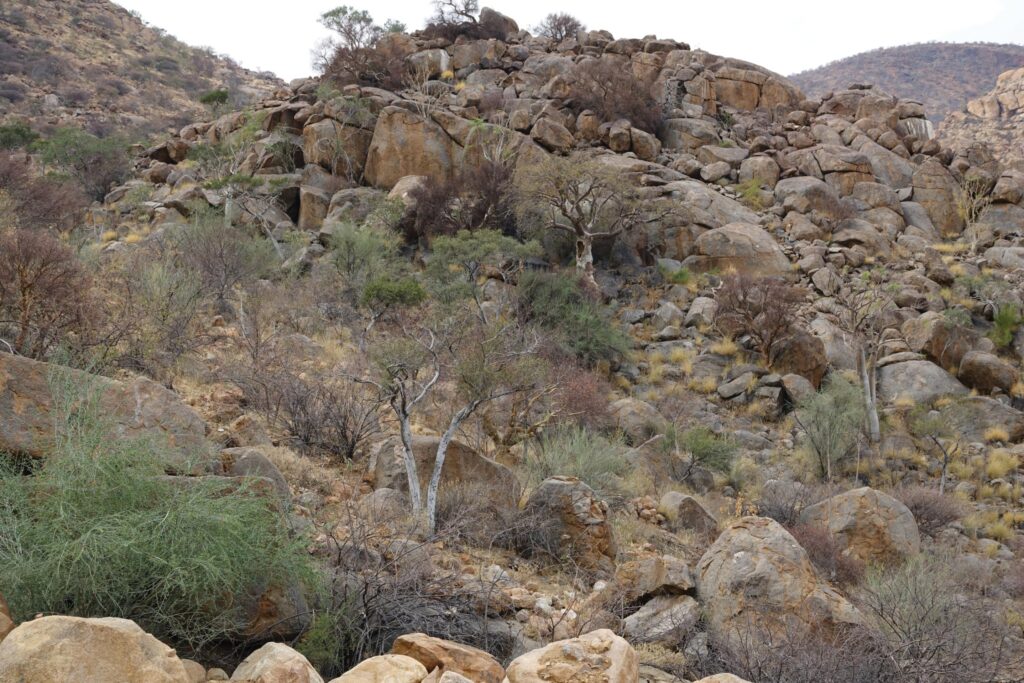
Hunting kudu in fissured obscure mountain-country above all means long hours of patient glassing. The first afternoon thus found us on a high vantage point within the southern crater rim. In the rugged slope, in this disorder of boulders and thorny bushes, we gradually spotted several Hartmann zebras, which, hanging their heads stood motionless in the shimmering heat, to eventually, when the sun was nearing the horizon and it became cooler, start to move, snorting leisurely.
Meanwhile, when we had a breather on our descent into the valley in the commencing dusk and for a last time glassed the foot of the crater rim, spotted a kudu bull some distance away. Coming up from a ravine he moved to a black-thorn tree on a little rocky outcrop, lay the horns back into his neck to browse up into the tree and pick every reachable flower full of devotion. Then he stepped back into the ravine and was gone.
He appeared to still be somewhat young, but we took it as a good omen.
In this way we climbed some high vantage point every day to glass the wild surroundings for kudu bulls. We always spotted some Hartmann zebra and time and again klipspringers, who stood like sentinels on a boulder, watching their surroundings. Once also a group of female kudus. But in spite of all effort, we could not detect an old bull.
When on a morning we had glassed a particularly obscure terrain in vain, I pointed into the wild confusion of big boulders and bizarre Commiphora trees of a depression through which a dry riverbed with gnarled leadwood trees on its banks was winding its way and said:
“This is the home of the grey ghost!”
“Unfortunately, he is not at home at the moment”, answered Patrick, to which I replied:
“You still have not fully understood the kudu. When you look down into a valley like this and don’t see a kudu, it does not mean that there is no kudu.”
On another morning, we had climbed the edge of a plateau. On the opposite side the southern crater rim rose steeply to culminate in majestic sheer cliffs. Touched by the first light of the rising sun, the basalt cliffs were aglow in warm red-brown colours. The valley, covered in a maze of thorn-bushes, was still in the shade. In deep happiness and unending deference, I first of all let my eyes roam across the untouched wildness of the surroundings. In its harsh grandeur many parts of Namibia have no equal, are, if at all, only comparable to the famous Northern Frontier District of Kenya or a few other regions of the Somali-Maasai Zone or the Sahel.
Then I put my binoculars to my eyes and started to glass the slopes. Suddenly a joyous jolt of adrenalin went through me. For a moment the horns of a kudu bull were glinting in the sunlight by now also reaching the valley. When we now patiently and carefully scanned that spot, not one, but eventually four kudu bulls slowly took shape. For a considerable time, we watched and assessed them, as they leisurely browsed around and time and again disappeared for a long spell to reappear again. One of them seemed to be mature and perhaps shootable, the others certainly too young – all not what we were searching for.
The morning of the sixth hunting day of the present safari, for Patrick thus altogether the sixteenth day in search of a bull kudu, found us squatting amongst some boulders of a ridge from where we could look down into a corrie, in which steep slopes were tumbling into a small valley from all sides. A wild terrain with deep ravines and rocky outcrops, wherein a kudu could vanish amongst big, grey boulders, Moringa and Sterculia trees, amongst bizarre Commiphora and blackthorn trees.
A few years ago, a landslide had occurred on a steep slope here during a torrential downpour which had piled up big boulders on both sides of a ravine, while the ravine was washed out deeply during subsequent rainy seasons. Through this landslide a small clearing was created on a slope, in which the first pioneer plants were slowly establishing themselves. When now glassing this terrain, and as my eyes just wandered across the clearing, it appeared to me as if suddenly the curtain of a stage was lifted, onto which now at last the leading actor of this drama stepped.
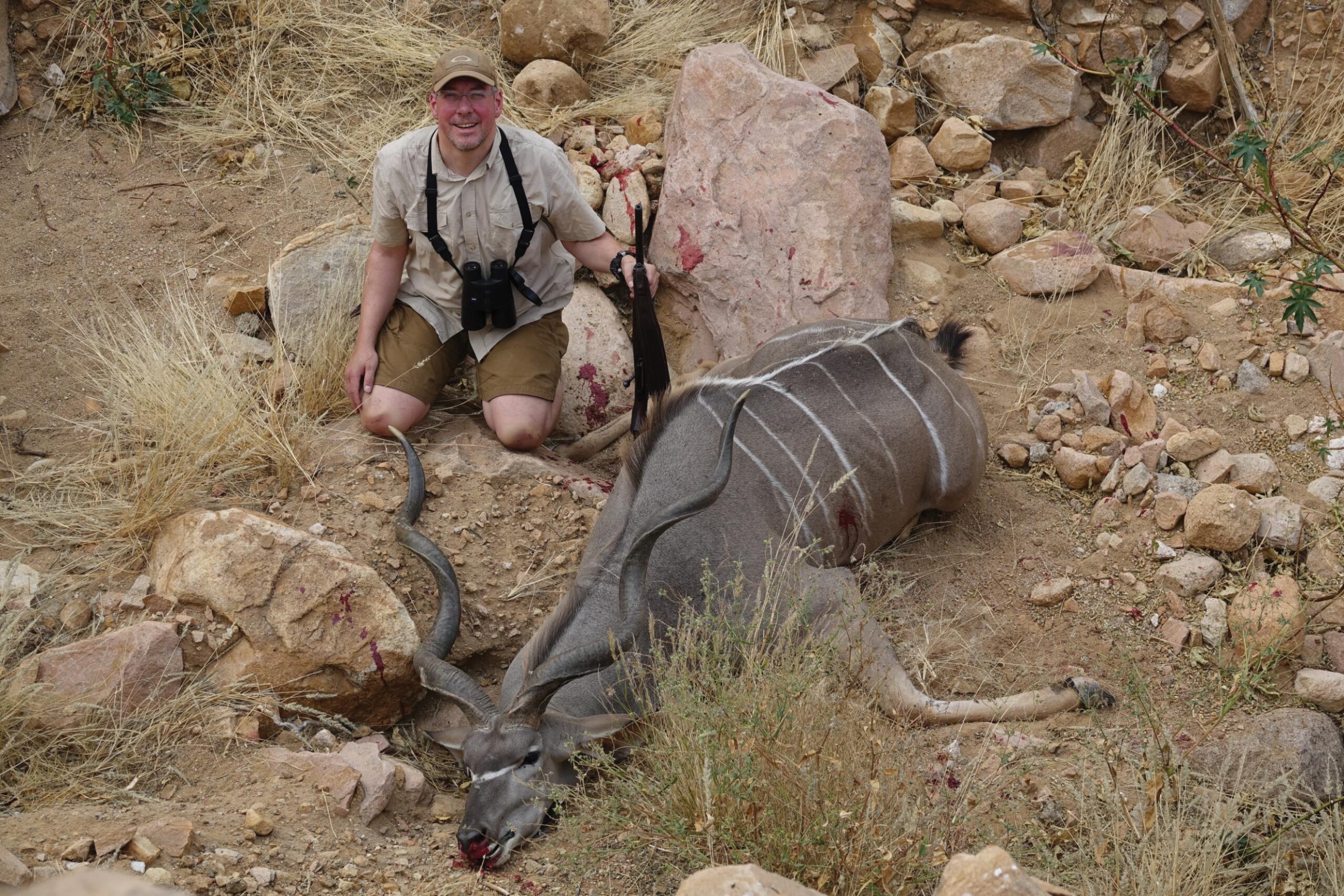
In great composure, one with himself and his harsh, wild surroundings, grey and ponderous, the heavy neck and the head carried low, the long beard on the underside of his neck caressed by the morning sun, the spirals of his magnificent horns projecting out far over his back, a big old kudu bull stepped across the clearance with dignified, slightly swaying steps.
Nothing, no other game animal, can match the consummate harmony of this moment, when a fully mature bull kudu materializes from invisibility and in indescribable, self-assured unpretentiousness steps onto the stage of his innate natural surroundings in his entire splendour.
Actually, only hindsight really brings the wondrous moment in all its grandeur to mind.
Because now it was time to take action, to make use of what could be the only chance.