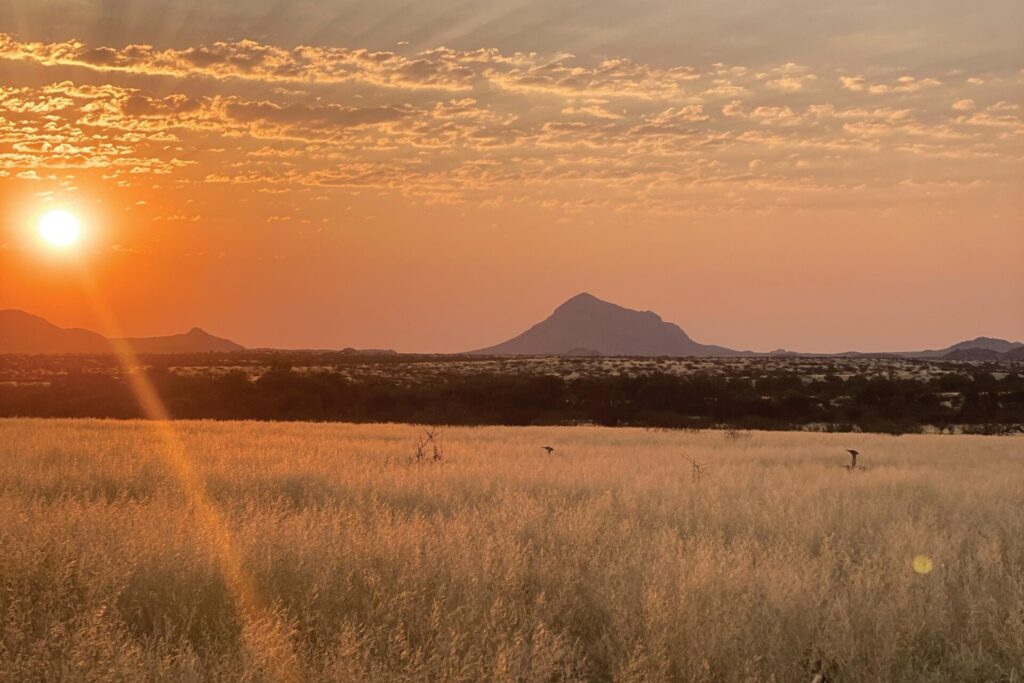
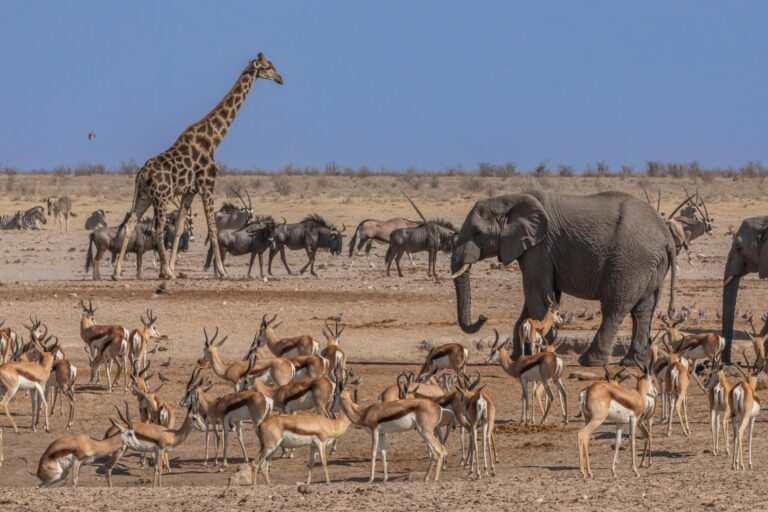
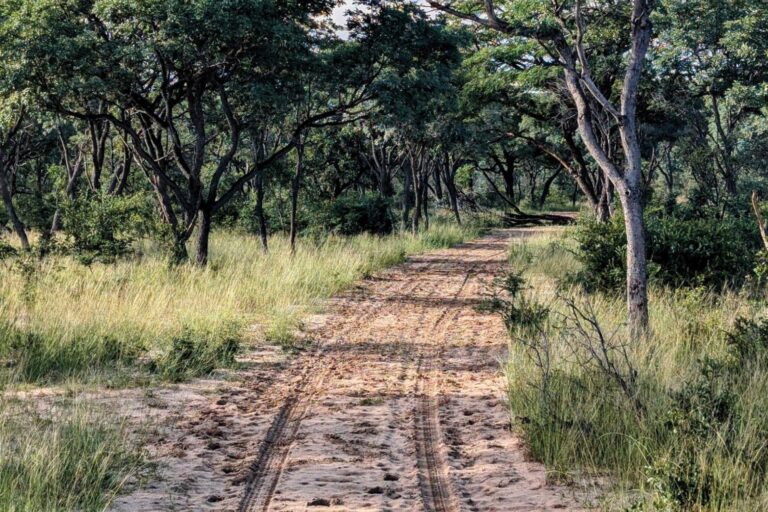
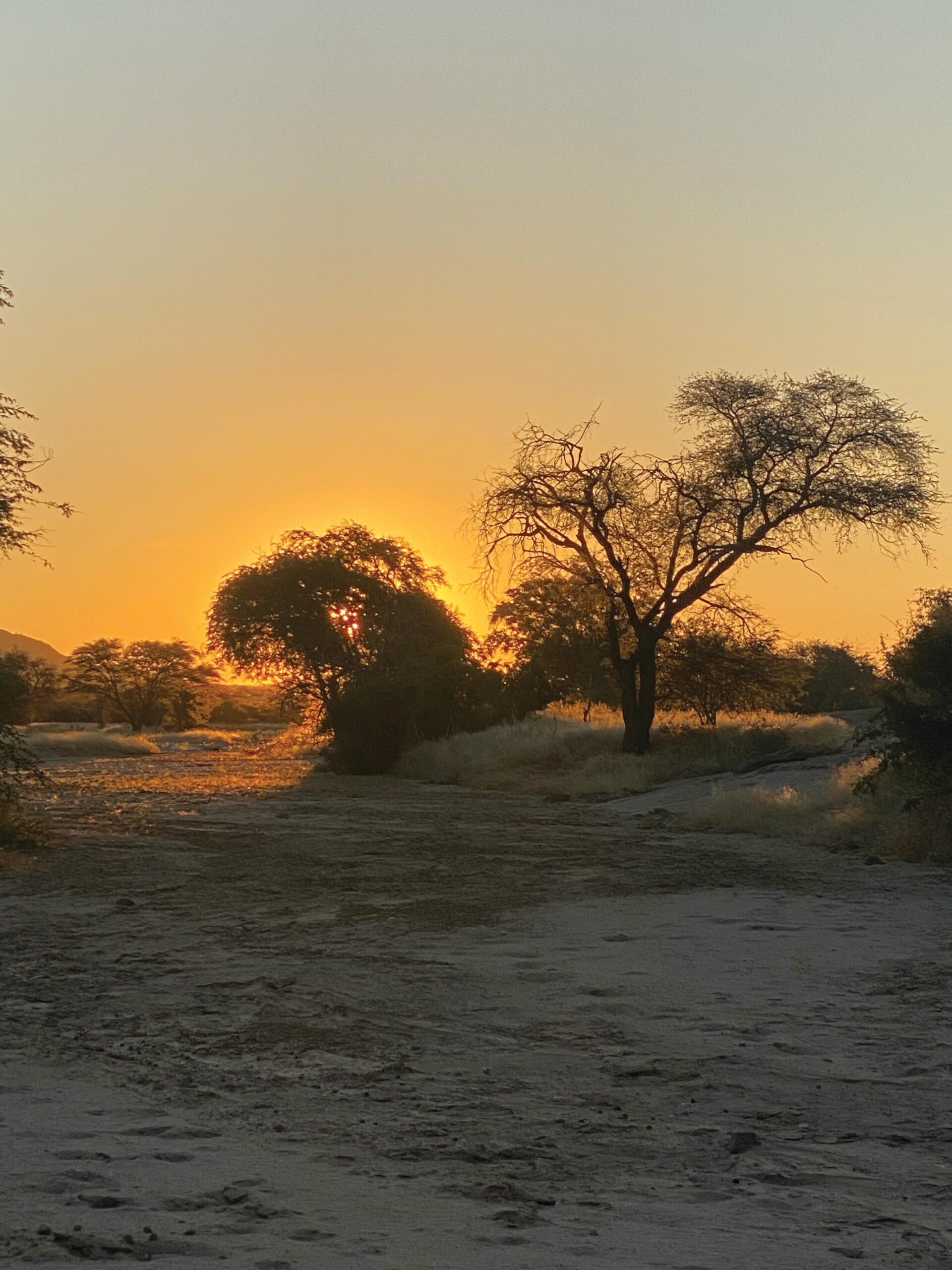
A little later in the season, with another hunter, we were on our way down to the dry riverbed again. In the afternoon, with the westerly wind in our faces, we had the heavy sweet smell of the blooming Ana trees in our noses. Like the game, I knew what this smell meant: lots of tasty Ana pods later in the year. They are like a magnet to game and turn such dry riverbeds into a vital lifeline in the tougher times of the seasons. Slowly stalking along the beautiful riverbed, we happened upon a springbok ram with three ewes and a magnificent gemsbok bull that was in its prime ‒ we decided that it still “needed” a couple or so years before it should be hunted. Around a bend in the river ‒ an island of Ana trees in the middle of the riverbed ‒ there is a white-grey granite slab on the eastern bank. On this slab we could now observe a yellow mongoose darting up the granite, presumably to get away from us. The mongoose, however, made a sudden turn and went into a small patch of grass growing from a crack in the granite. Then it flew back out into our direction and zig-zagged across the slab: completely oblivious to us, it was hunting a lizard. After a while it disappeared over the slab and continued its hunt on the other side, as we continued our hunt along the riverbed. The rest of the stalk was uneventful, only laden with images of the setting sun in dusty air filled with insects swarming underneath one of the blooming Ana trees.
A highlight for me as a hunter is observing other predators, especially in an area where they are not persecuted “to the full extent of the law.”
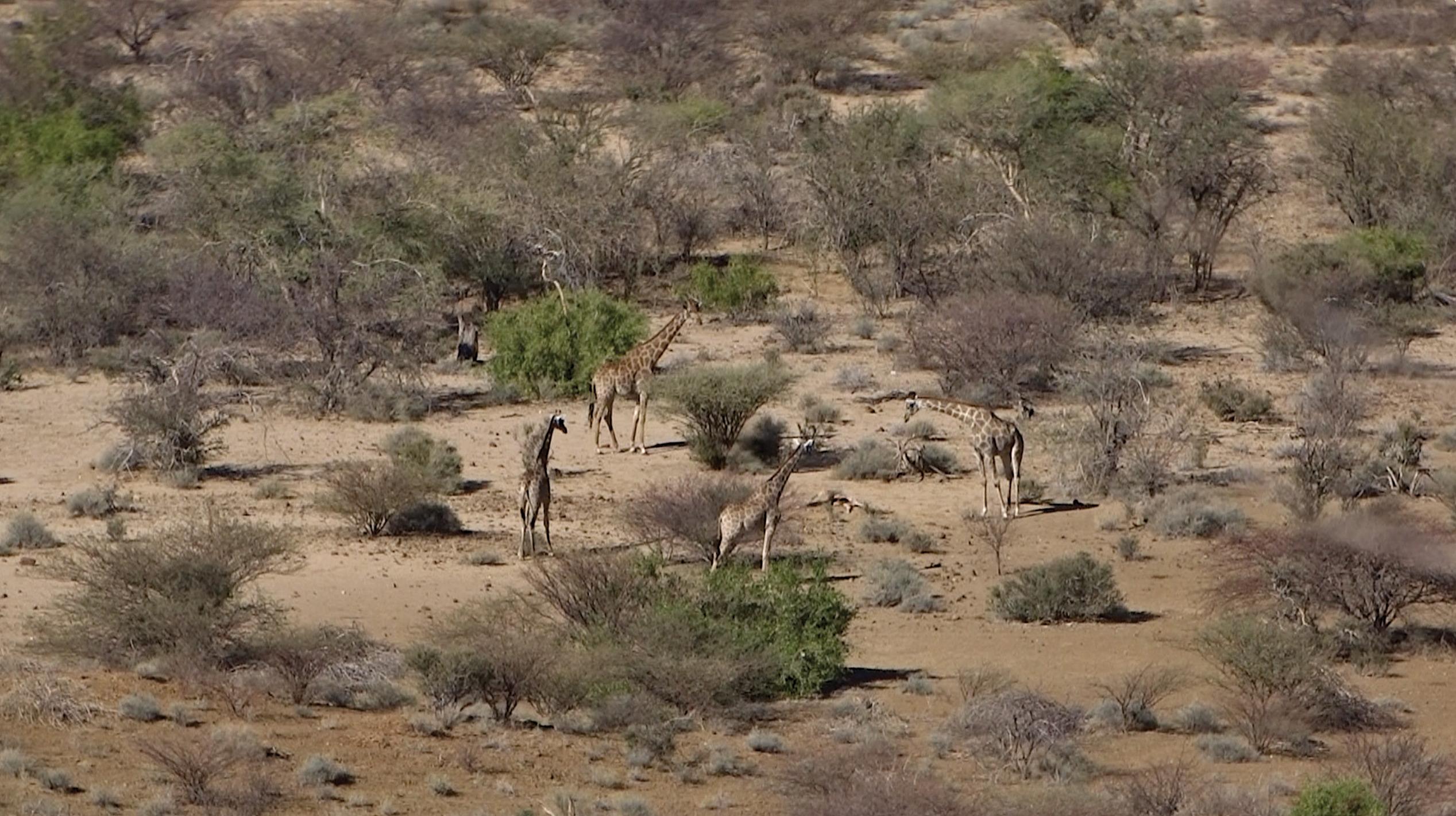
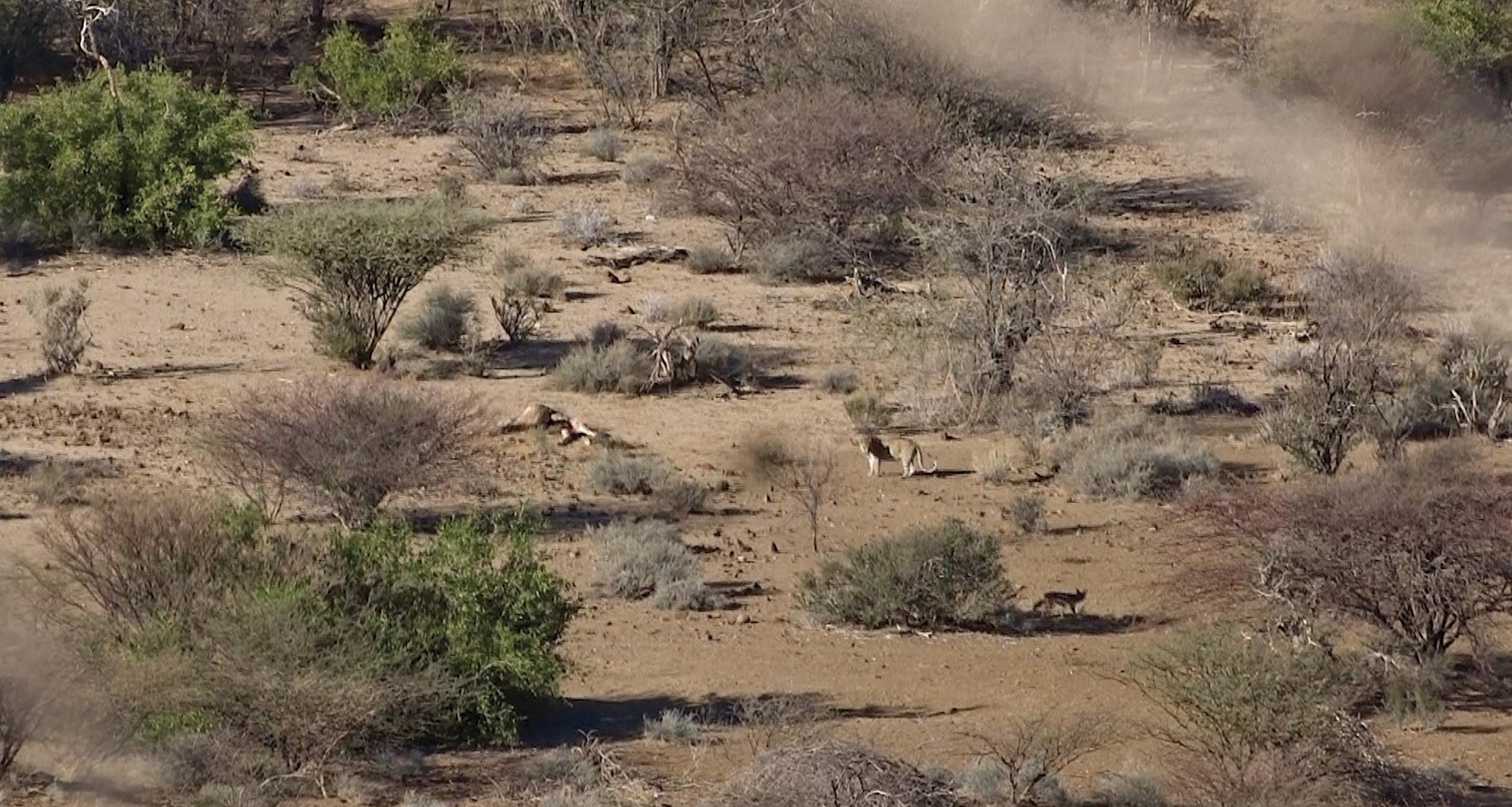
One such memory worth collecting, happened on an early winter morning while hunting for kudu. We had left the old Land Rover ‒ serving as the hunting truck ‒ in a small bushy area to climb up Dik Dik mountain and spend the next few hours glassing for kudu in the surrounding hilly landscape. We hadn’t even started our ascent of the mountain yet when we heard a jackal howling and yapping to our right, not far away. We couldn’t see him, and not giving it much thought we continued and went up the hill to a suitable glassing spot almost at the top. Looking down to where we had come up and heard the jackal, I saw an unfamiliar object lying in a clearing near a small riverbed. Putting my binoculars to my eyes, I immediately had what seemed to be a dead baby giraffe and two jackals in sight. And then: a big leopard! While still trying to figure out how a leopard could kill a giraffe, albeit a small calf, we could witness a fascinating spectacle. The leopard was lying under a tiny tree ‒ presumably with his stomach full ‒while two jackals tried to get closer to the kill. They weren’t courageous enough yet to come closer than a respectful distance and always back-tracked before the leopard had to do more than growl. After a while the jackals split up and came from two different sides, a tactic that seemed to be more effective. One jackal approached from the left while the other waited at a safer distance to the right. The left jackal came too close to the kill, prompting the leopard to get up and chase the jackal away ‒ which gave the second jackal a chance to try his luck. However, he only got as much as a sniff of the giraffe before the leopard was back to defend his kill. The leopard went to lie down at his little tree again. The whole game started anew again and again. At one point the leopard took a few bites ‒ as if he was considering finishing the whole giraffe before anyone else could steal something ‒ and then made a futile attempt to cover his kill.
After a while we saw a third jackal approaching and I thought that now the leopard would definitely be outsmarted. The other two jackals were still busy with their game and the third one seemed to jump right in. But when the other two noticed the third jackal, it quickly became clear that he was an intruder. The first two immediately gave chase to the third one. One in particular was going with tenacity after the outsider, who first made a few sidesteps but then dashed off, with one of the pair in hot pursuit. They went through a little ravine, and when they came out on the other side, a steenbok also appeared, a little confused. The steenbok ran up a little incline and from there watched the two jackals swerving to the left and then back again. The steenbok somehow decided that he needed to get out of the way, but in his efforts he ran right across to where the jackals were coming back. The first jackal had already passed when the second jackal noticed the fleeing steenbok. He stopped chasing off his kind and rather went after the steenbok. The jackal quickly closed in, but before we could see any drama unfolding, they both disappeared behind a slope.
Back at the kill, the leopard was under his tree again and there was no sign of the remaining jackal.
I took the chance to disappear behind the bushes over the top of our lookout spot for a few minutes. When I returned, both jackals were back and at that moment the leopard was walking towards his giraffe. He probably saw me coming over the crest, as he looked up at me and then quickly disappeared from the scene, crouched down low. I was a bit mad at myself for disturbing him but at least this gave the jackals a chance to get to the kill and eat their fill. For us the excitement was gone for now and we finally, after more than an hour, could focus on looking for our actual quarry. We saw lots of game, and just as we were about to call it a day for the morning a young kudu bull traversed across our field of view. Although he was not a shooter, this seemed to round off an eventful morning. When the bull had disappeared, we started to pack up. Before we could leave though, the penultimate scene unfolded. A group of giraffes approached from the northeast. At first it seemed as if they were just on their way to the waterhole or to change browsing areas. However, they directly came to the site of the morning spectacle and apparently the previous night’s drama. It quickly became obvious that this was the group from which the baby giraffe had been taken. The giraffes all went to the site of the kill and for a while nervously walked around the dead baby giraffe until one cow went to sniff it, while the others just stood by in a semicircle. What an eerie and chilling atmosphere!
When they left, we could finally go down. On our way to the car we investigated the leopard kill, as I was still curious about how the leopard had managed to kill the little giraffe, especially considering that the mother would have fiercely protected her calf. Upon closer inspection we noticed that ‒ although there were bite marks on the throat ‒ the skull of the giraffe was completely smashed. Our only logical explanation was that in her efforts to protect her calf, the cow must have kicked the baby in the head, thereby killing it. Tragic from the human perspective, but a “normal” occurrence in nature.
A few days later, only a few tufts of hair and tiny pieces of bone were left ‒ nature had done its work.
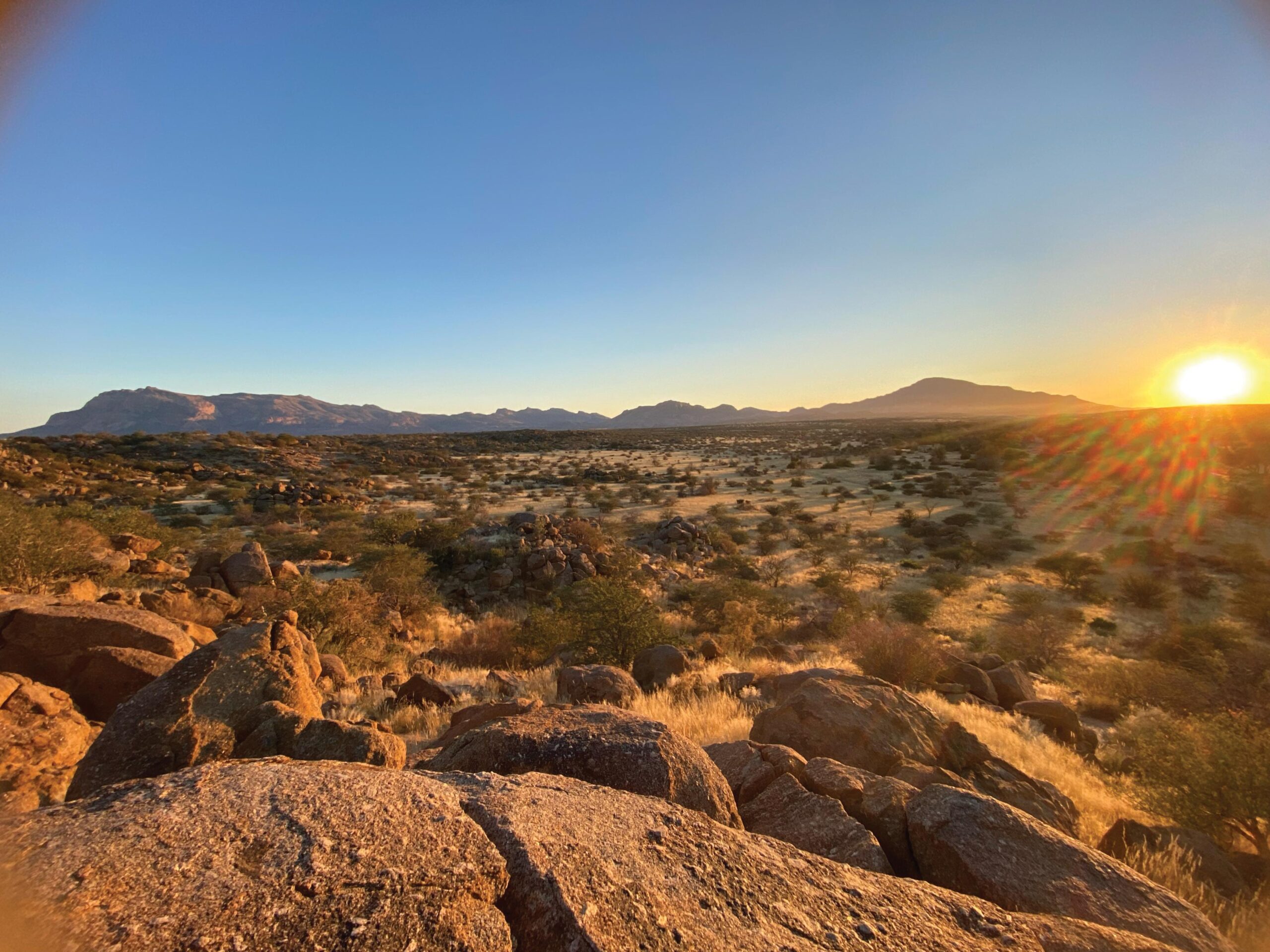
Some little moments a hunter experiences while out in the wilds are also forgotten or shift into the subconscious and only pop up when triggered by certain sightings or being in the same area. One such memory that I had completely repressed came to mind again when we (successfully) hunted klipspringer in August. We were hunting in an area dominated by grey-black rock that is of volcanic origin and has a very high iron content, often “clinking” metallically when two rocks hit each other as you walk over them.
I remembered that in this exact same area, five or six years ago, I had watched how one of the endemic black mongooses was chasing back and forth around a klipspringer during the course of maybe 5-10 minutes. The klipspringer was obviously too big to fall prey to the mongoose, and it almost seemed as if they were playing a game. Again, it was one of those sightings that was completely trivial to our hunting quest but what makes being out there worthwhile.
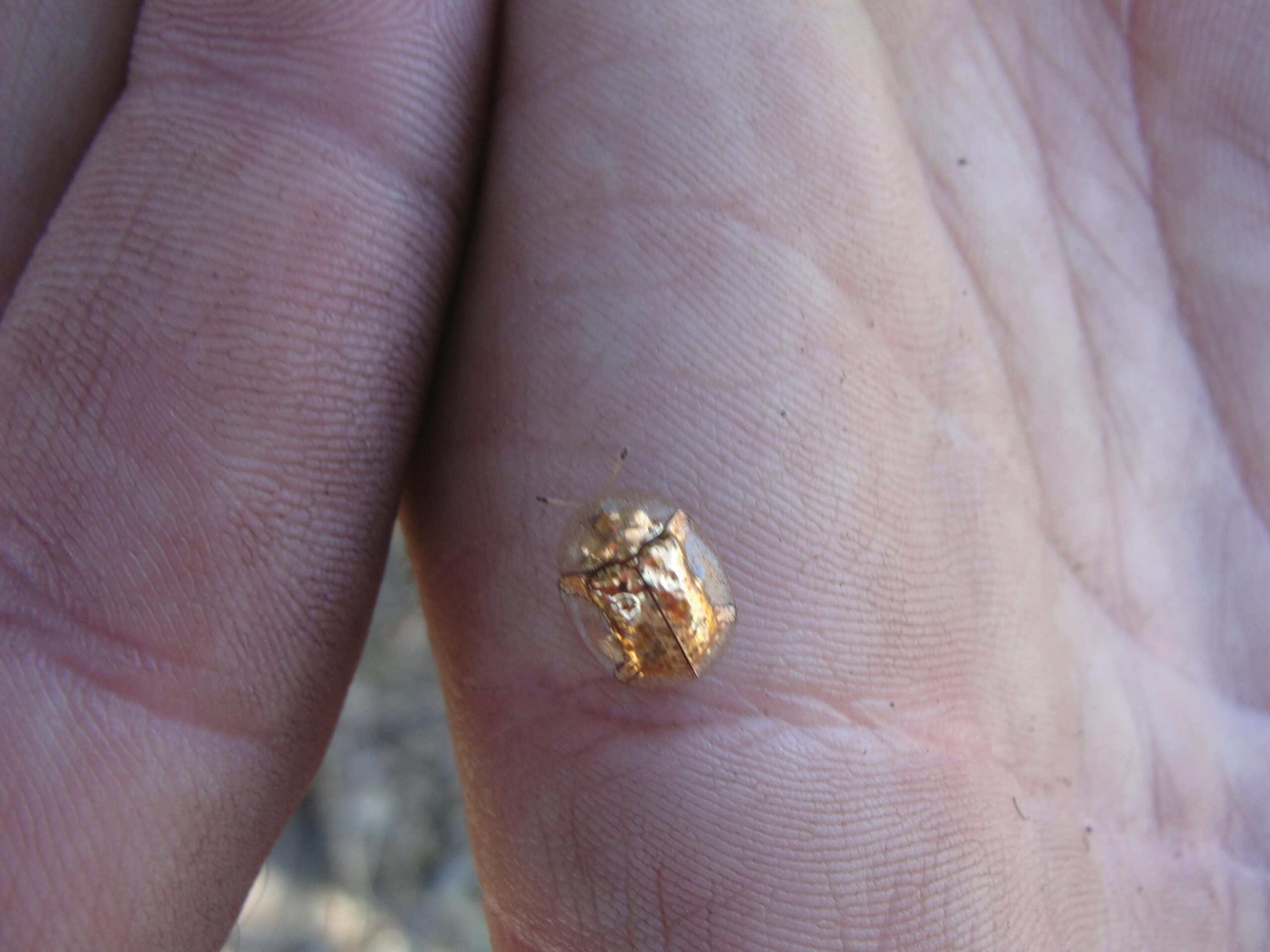
Every hunter probably has similar memories that pop up every now and then (or not). For me they are a vital part of why I hunt. I, for example, have memories from 15 years back of a completely golden shiny beetle that I found while hunting elephant in the Bushmanland hunting concession. Or the moments of camaraderie shared with San (Bushman) trackers while helping out with a leopard hunt as a teenager (being the driver for the hunting party sitting in the blind and me waiting at the truck with the trackers).
Or of an early morning on my property where I was able to observe two brown hyenas returning to their denning area in a magnificent granite area in the first sunlight. “Actual” hunting, of course, also makes up these “million little things”.
One of the moments being when you stalked an old gemsbok bull, and he is even closer than you “planned”. Where you can see every hair on his hide and the reflection in his eyes. The hunter slowly raising his open-sighted rifle and taking the shot at less than 30 yards.
Or the relief and feeling of fulfilment after having carried the quartered meat of a Hartmann’s Zebra or Kudu bull from the mountains to the nearest place the hunting truck could reach.
Or late nights spent at the campfire in deep conversation with hunters who have become mates.
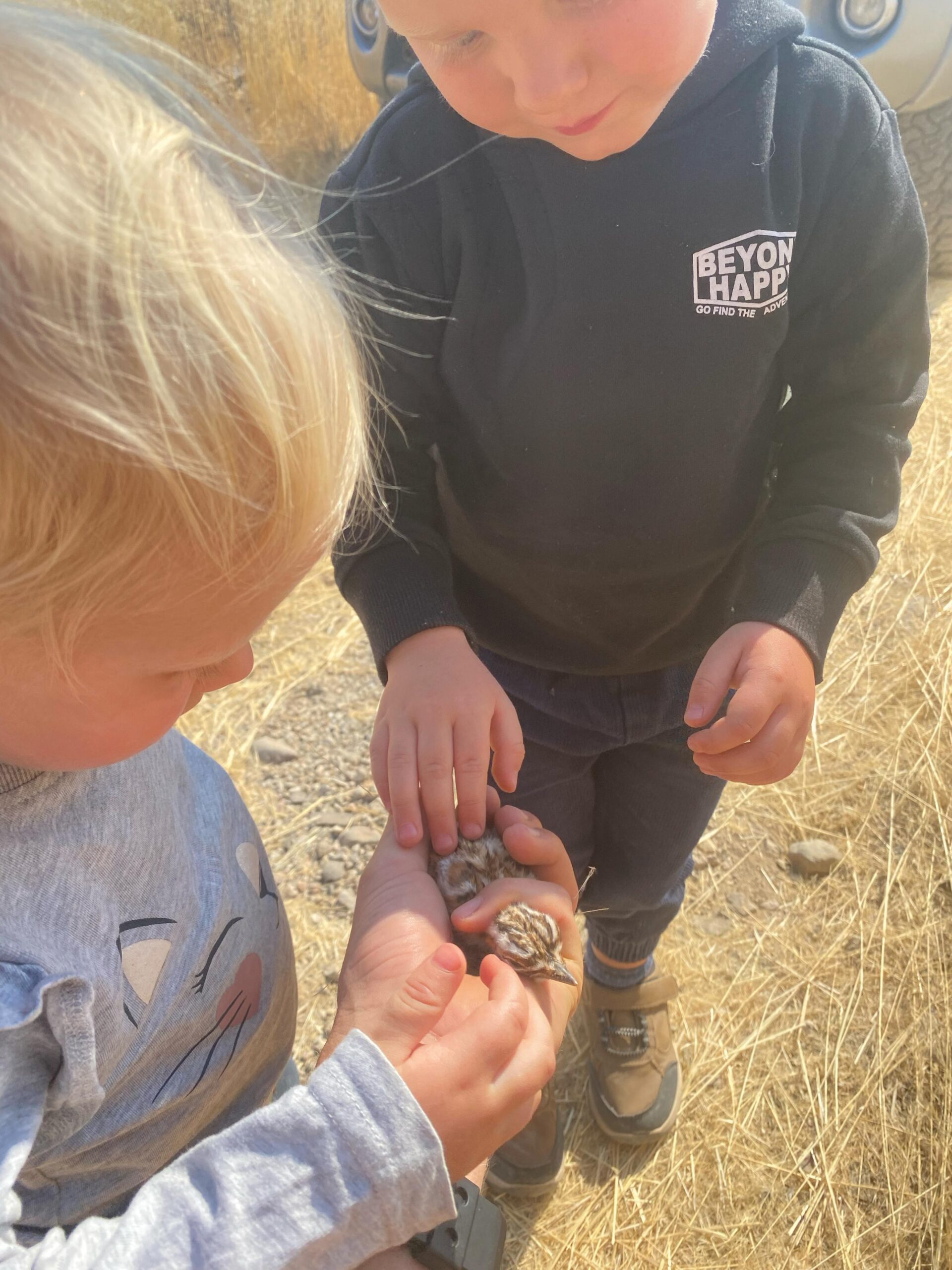
Or watching your own children experiencing the small wonders of our natural world. In our evermore fast-paced world, which has also found a grip on hunting, where one often gets the impression that the experience or the collecting of memories is dominated by bagging as much as possible in a time as short as possible, and bragging about it at the evening dinner gathering, I wish and hope that every hunter can now and then find the little moments and things – and cherish these. Because I truly believe that hunting isn’t a big thing, it’s a million little things.