
From data to decision

The science and the strategy in conservancy quota setting

Robust, collaborative and driven by science. This is how you can describe the process that the Ministry of Environment, Forestry and Tourism (MEFT) has adopted to set quotas in communal conservancies. Richard Fryer, the Control Warden for Human-Wildlife Conflict and Conservation Hunting at MEFT, who manages this process, explains that they needed their quota-setting system to include a more robust process that could withstand scrutiny from anti-hunting critics. To address these concerns, Namibia shifted to a more scientific and evidence-based approach. This change aimed to enhance the credibility of the quotas issued for hunting and ensure they were based on the best available data. Kirsty Watermeyer

The quota setting is overseen by the Quota Setting Coordinating Committee, which is part of Namibia’s Department of Natural Resource Management. This committee includes representatives from the Directorate of Wildlife and National Parks, the Directorate of Scientific Services and the Namibian Association for Conservancy Support Organisations (NACSO), with consultation from conservancies and also the hunting operators,” Richard explains. He adds that they embark on a year-long vigorous process that will determine quotas for a three-year cycle.

Richard points out that there is a vast area to cover, with 86 conservancies, across different landscapes. Considering this, and the fact that there is not the budget to do costly annual aerial surveys of the entire country, the team needed to come up with a new approach that is rooted in science. This resulted in the current system which is a collaborative and multi-faceted approach, involving various stakeholders and layers of scrutiny.

The process involves specific task teams for different categories of wildlife: elephants, predators, wetland species and general game. Each team is led by experts who gather data and make recommendations based on scientific research and field observations.

“By involving multiple stakeholders and relying on rigorous data analysis, Namibia aims to ensure that its hunting quotas are both responsible and transparent.”

FIRST, THERE IS DATA COLLECTION

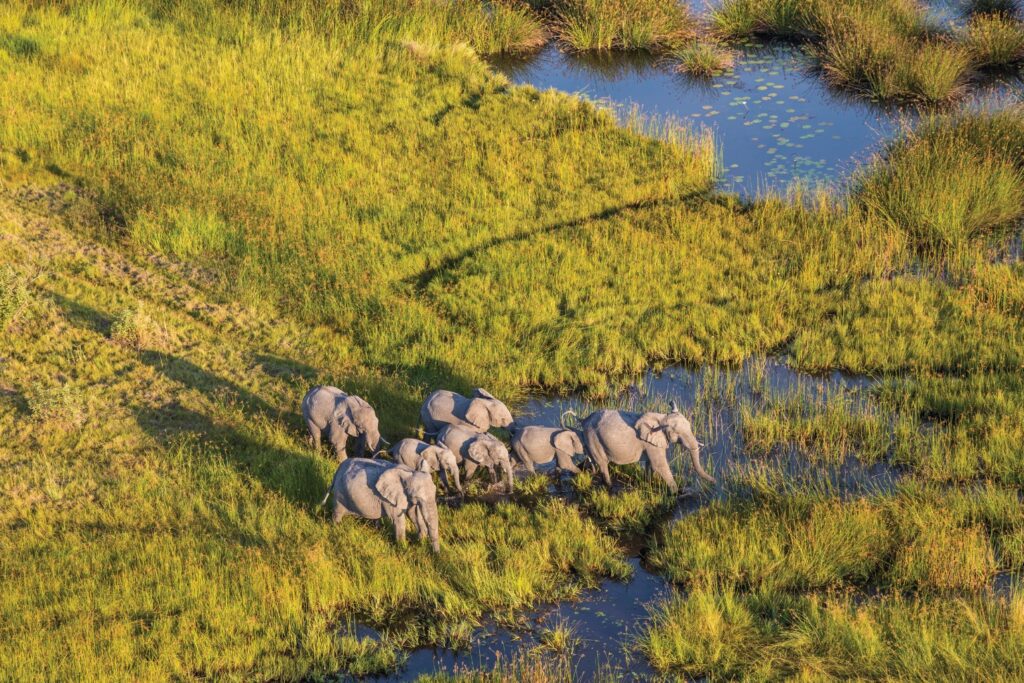
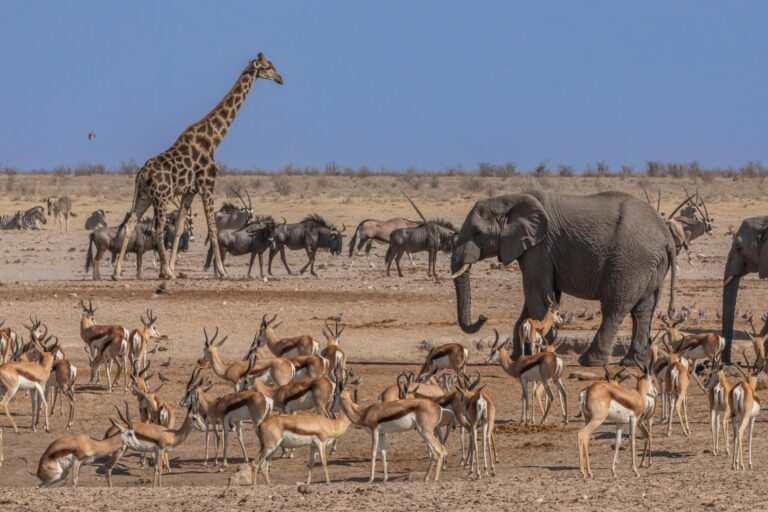
Different approaches to data collection are used for different species. For elephants, data is collected from aerial surveys and other sources. For wetland species, annual game counts are conducted using helicopters to gather data on species like hippos and crocodiles. Quotas for general game, such as springbok and kudu, are determined through annual game counts conducted by conservancies with support from NGOs and regional MEFT staff.

The approaches differ with regard to predators. There is more comprehensive scientific data available about lions in conservancies, which helps to guide quota setting. Whereas no quotas are set on species like cheetahs and spotted hyenas, because the scientific data is insufficient.

THEN THERE IS CONSULTATION AND REVIEW

After collecting the data, the task teams review the collections and feed the data findings into technical programs that calculate recommendations based on various factors such as population trends, environmental conditions such as droughts as well as other factors such as ecological carrying capacity of the land. This gives a first round of recommended quotas, which are then discussed with conservancies and regional staff to gather local insights and address any concerns. This consultation process is crucial as it ensures that quotas are practical and consider on-the-ground realities.

Richard explains that although they don’t set off-take quotas based on incidents of human-wildlife conflict, they do engage with conservancies to address their concerns and incorporate these into the processes. “We do not set quotas on animals for which we lack scientific data. For example, while there is substantial human-wildlife conflict data on spotted hyenas, we do not set quotas for them because we lack the necessary scientific data. We receive pressure from conservancies to establish quotas for animals involved in significant human-wildlife conflicts, but we won’t do so in cases where the scientific data is lacking. When it comes to problem animals and their declaration, there are other avenues to follow which are guided by the HWC Policy.”

The process follows an adaptive management approach, where off-take numbers are determined based on information gathered and feedback loops. And, as Richard explains, “the process is very collaborative at this stage. Each task team leader will go out and consult with various people, including conservancies, hunting operators, researchers and experts in the field. Then they come back and discuss these findings among our team again.”

Some of the other areas of consideration in setting the recommendations include a review of environmental factors like droughts and assessing the quality of trophies. “If the quality of the trophies are going down, this is a warning sign that we look out for. So we are also monitoring things like skull measurements of leopards or tusk weight of elephants.”

Richard points out that some species, like desert-adapted elephants, are never placed on quota and that Namibia adheres to international regulations set by the Convention on International Trade in Endangered Species of Wild Fauna and Flora (CITES), which restricts the number of trophies that can be exported.

NOW, READY FOR APPROVAL AND FINALISATION

Once the process of reviewing the recommendations together with conservancies has taken place, the recommended quotas are presented to a technical steering committee consisting of senior officials and experts. If approved, the quotas are forwarded to the Minister of Environment for final sign-off. Only after the Minister’s approval are the quotas officially set.

This final step includes the quota allocation determined for each animal species, i.e. recommendations are given for how many animals may be used for trophy allocation – by the traditional authority, and by the conservancies for their own use.

Namibia’s quota-setting process for trophy hunting is a comprehensive and scientifically driven approach designed to balance conservation goals with sustainable wildlife management. By involving multiple stakeholders and relying on rigorous data analysis, Namibia aims to ensure that its hunting quotas are both responsible and transparent. The process demonstrates the country’s commitment to conserving its wildlife while addressing the complex dynamics of trophy hunting.

From the 2025 issue of Huntinamibia

Our Partners

Related posts

Securing the Future of Ethical Conservation Hunting in Namibia

Namibia’s hunting community stands at a pivotal juncture. For five decades, professional hunters, trackers, operators, conservancies and rural partners have protected wildlife and ensured that land remains dedicated to conservation. Our model, grounded in ethical hunting and sustainable use, is recognised worldwide as one of the most successful conservation systems.
Read More »

A million little things

Hunting for me goes beyond the obvious, beyond the daily grind and the collecting of trophies. Even beyond the now hackneyed phrase of “collecting memories” ‒ something probably nobody can really define. Once you allow yourself as a hunter to actually and consciously take in moments and breathe in air,

Read More »

The giant from the woodlands

We were kneeling in the hot sand. It was early April, yet the sun was burning down on us mercilessly. Poldi was sitting behind me. It was his second visit to Namibia and therefore he now knew that in Africa, too, the scorching heat and biting flies do come to

Read More »

Read the full 2025 issue