TAFEL DEBRIEF IN NAMIBIA

An intensive nature experience and pure hunting adventure

by Uwe Mark

Experiencing intense moments in nature, embracing physical exertion and deprivation as a challenge in order to come to know hunting in a way that is rarely possible in today’s hunting grounds in Germany. This was the motivation for my hunting companion Holger and me to travel to Namibia.

The focus of our hunt would not be the trophy itself, but the journey to bagging it. It was to be a challenging journey with many kilometres of stalking, without technical aids or any frills. Hunting behind a game-proof fence, shooting from a car or sitting in hides at waterholes were completely out of the question for us, and the venison we were going to harvest was to be fully utilised…

And so it happened that we got in touch with professional hunter Hagen Denker. The way he outlined the hunting process, and the prospect of a sustainable and purist wilderness hunt convinced us. Hagen met us at Hosea Kutako International Airport in Windhoek, and thus started an eleven-day adventure in his excellent, truly allround care.

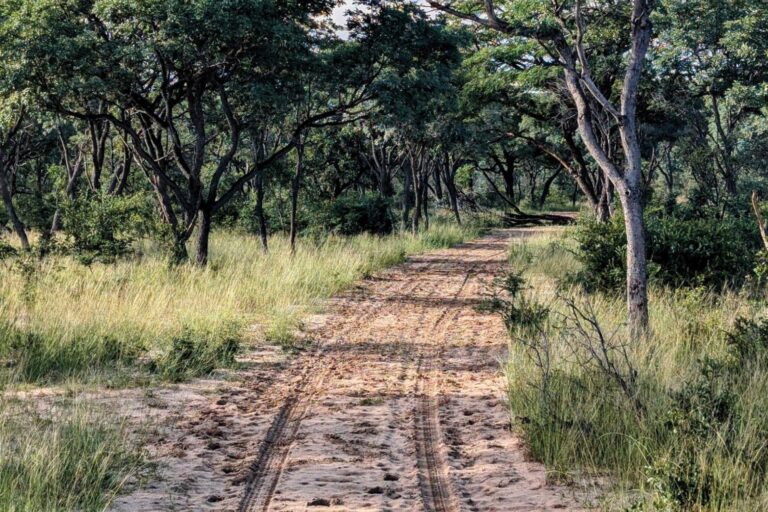
The 2.5 hours’ drive to Ameib in his white Toyota 4×4, a ubiquitous brand on Namibia’s roads, gave us an opportunity to get acquainted. Ameib, the Green Place, is the guest farm of the Denker family, adjacent to the 14000 hectare Reficiens Private Hunting Concession. As darkness fell, we got into a 1973 Series 3 Land Rover with single cab and open loading space. We drove through the bush, dimly lit by the headlights, along barely visible paths, through dry riverbeds and between rocks for a good half hour until we reached the hunting camp, the long-awaited destination of our journey.

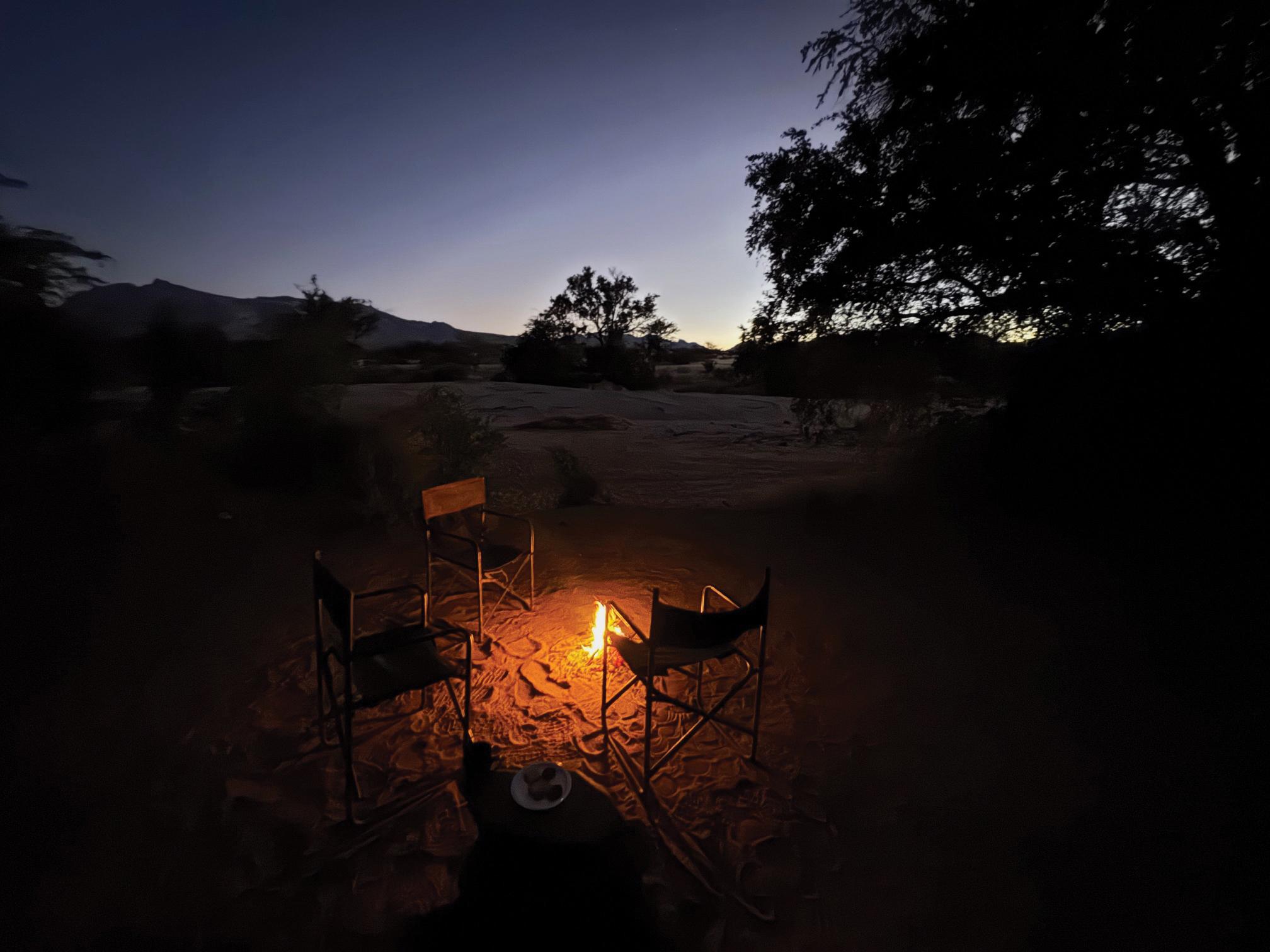
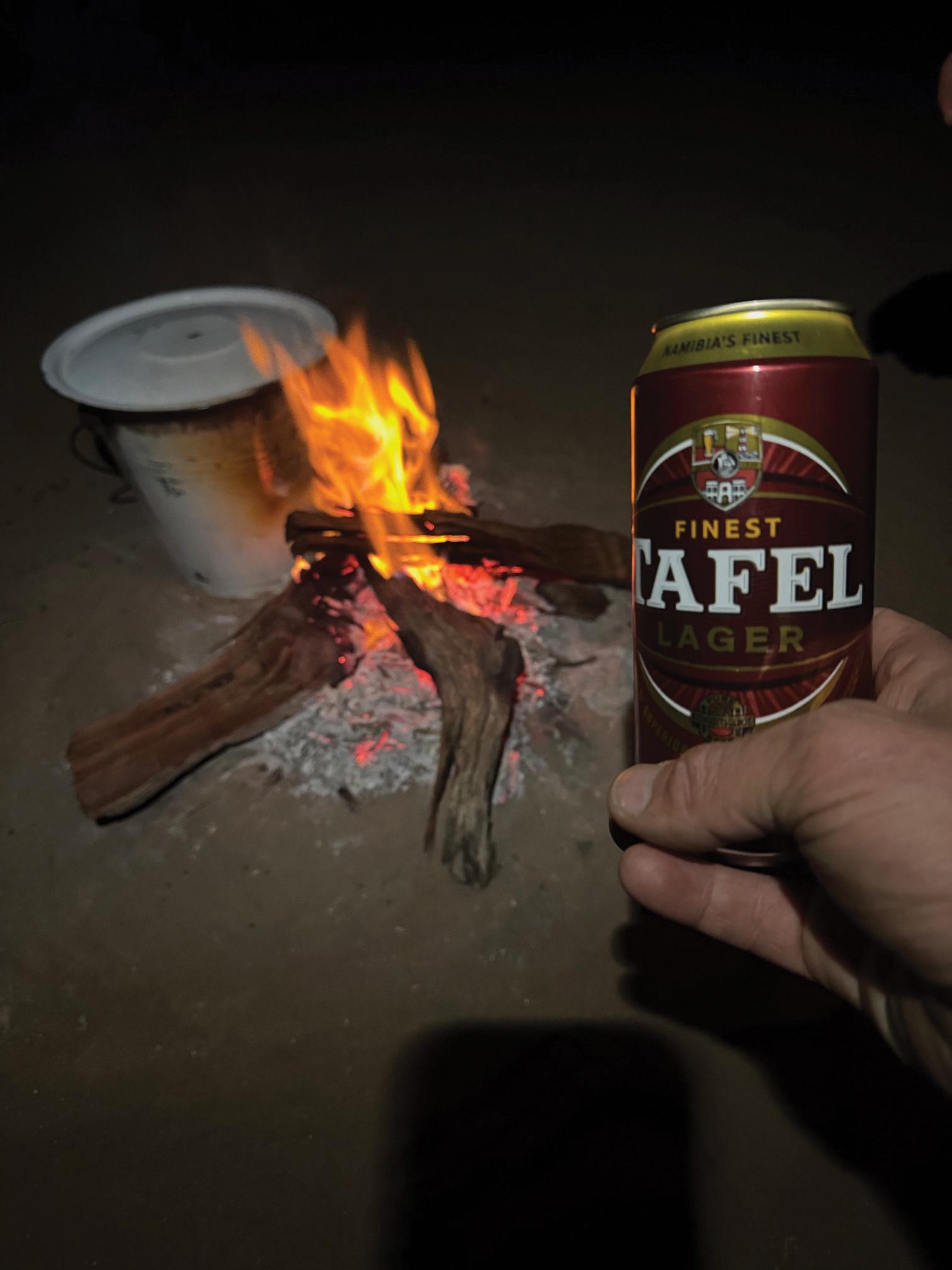
The campfire, built of the very hard and longsmouldering camel thorn wood, was already burning, tended by camp assistant Butti, who was to take very good care of us in the days to come. Above us, the magnificent constellation of the Southern Cross was shining against the backdrop of the Milky Way – we felt like strangers but somehow also at home.

The wake-up call on the first day of stalking was at 5:40. We gathered at the campfire and started the day with strong coffee and a chunky rusk. A cheerful exuberance for the unknown took hold of us – stalking in the African bush for the first time. What would we encounter? Everything would be real, no zoo, no safari park.

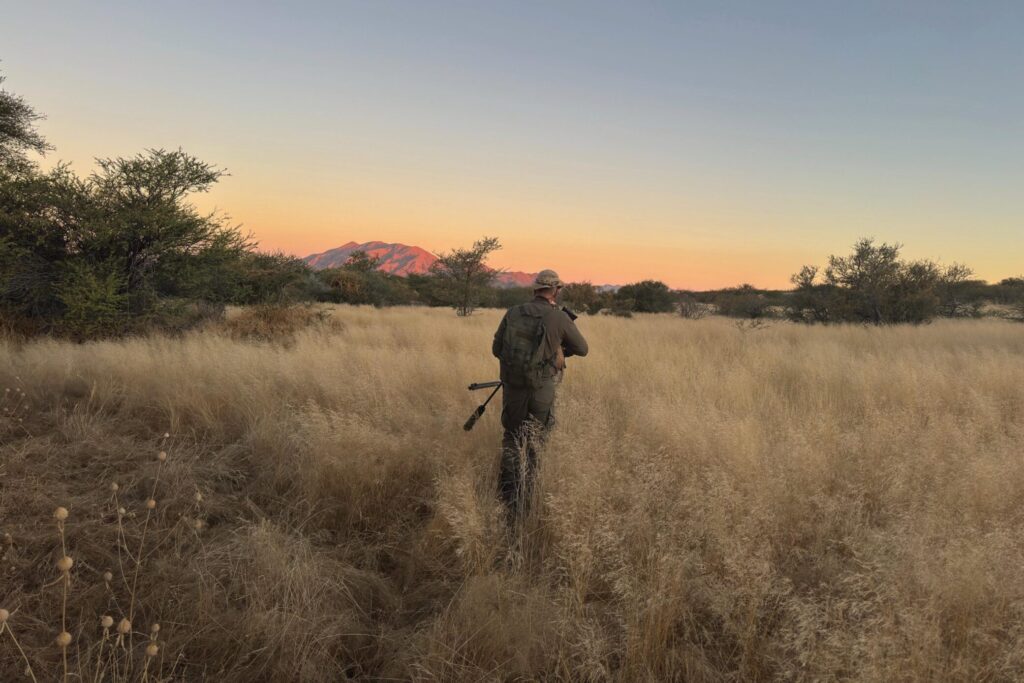
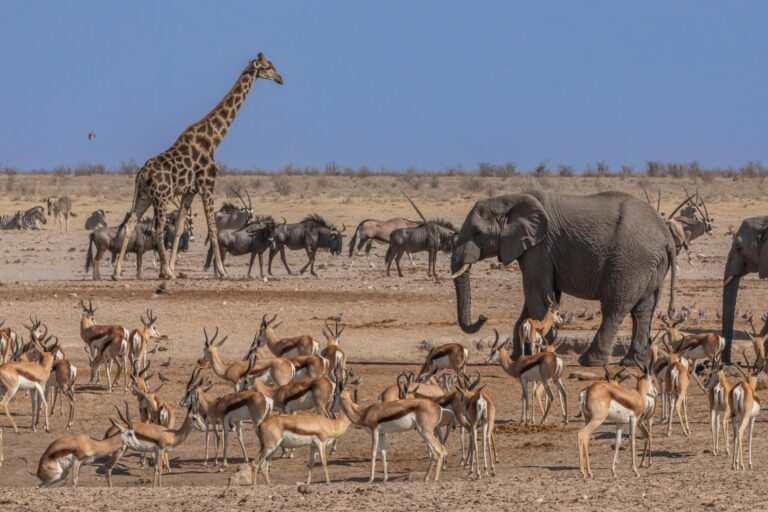
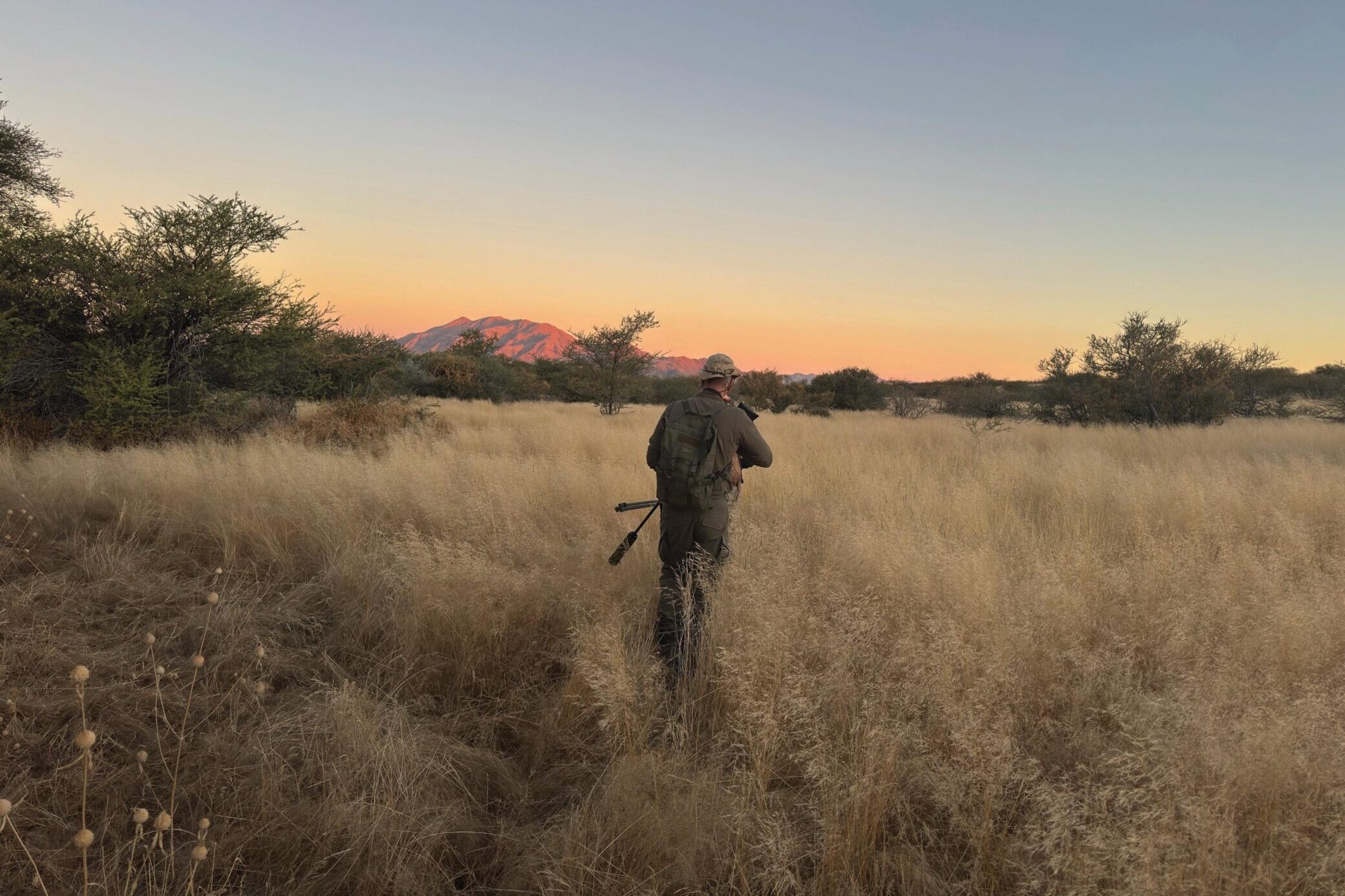
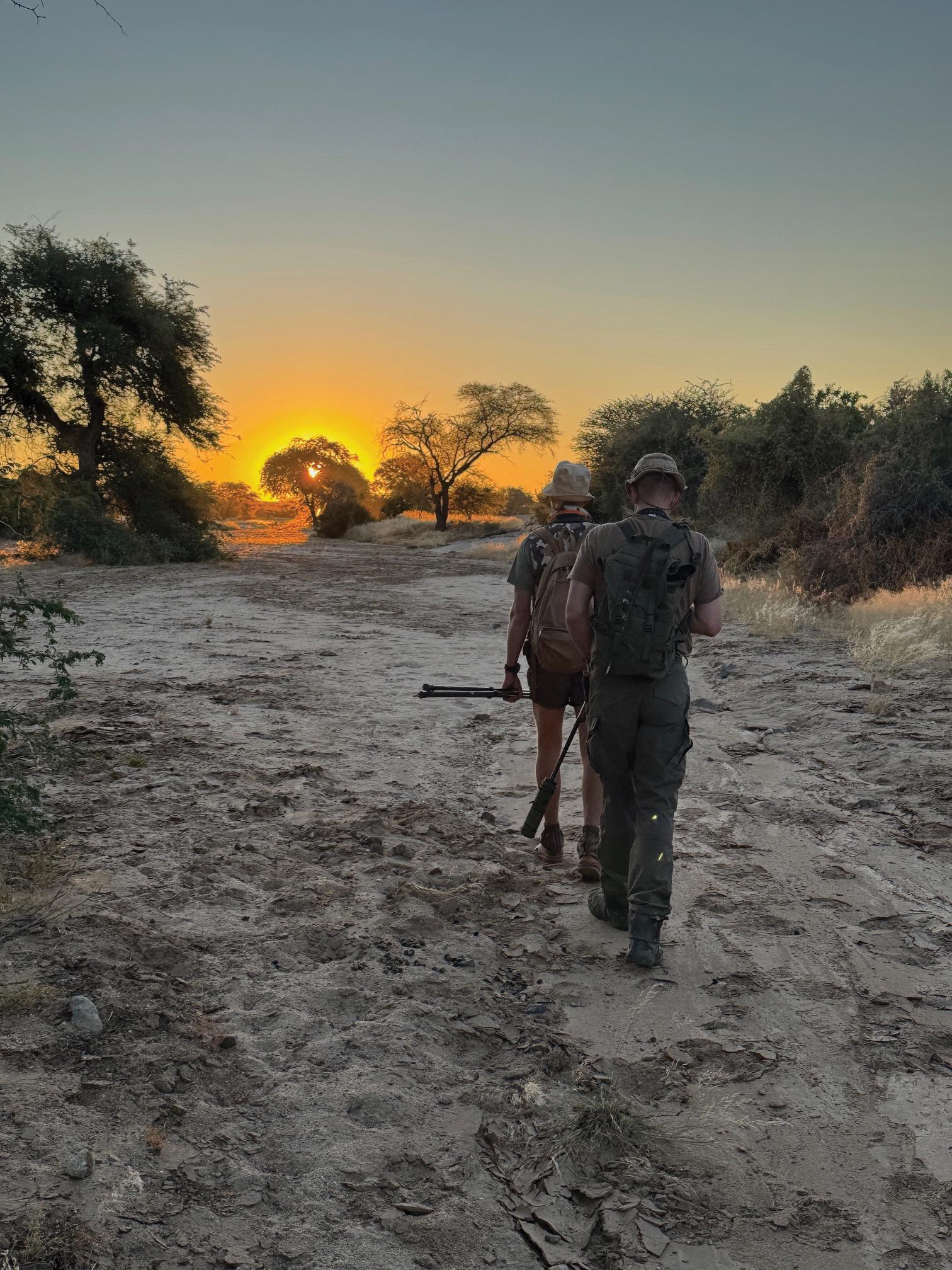
At sunrise we were on our way in the Land Rover, rumbling to a dry riverbed. There we test-fired our .300 Winchester Magnum Mauser rifles at a distance of 100 metres. Afterwards we roamed through a seemingly endless plain of bristlegrass, framed by rugged red mountains and surreal rock formations. In this breathtaking and untouched habitat we spotted plenty of game. Gemsbok (Oryx), zebra, giraffe and springbok crossed our path. On the second day of stalking we found fresh hyena tracks. Hyenas are plentiful in this hunting area, and so are leopards. Our stalk was noisily accompanied by Grey Loeries, or Go-away-birds. It didn’t bother us at all that we didn’t bring our rifles to bear during those first few days. Back at camp, a small but recurring ritual developed – we gathered around the campfire every evening and with a Tafel Lager in hand debriefed (we are both of military background) the day’s events. Soon we coined the term: Tafel debrief of Ameib.

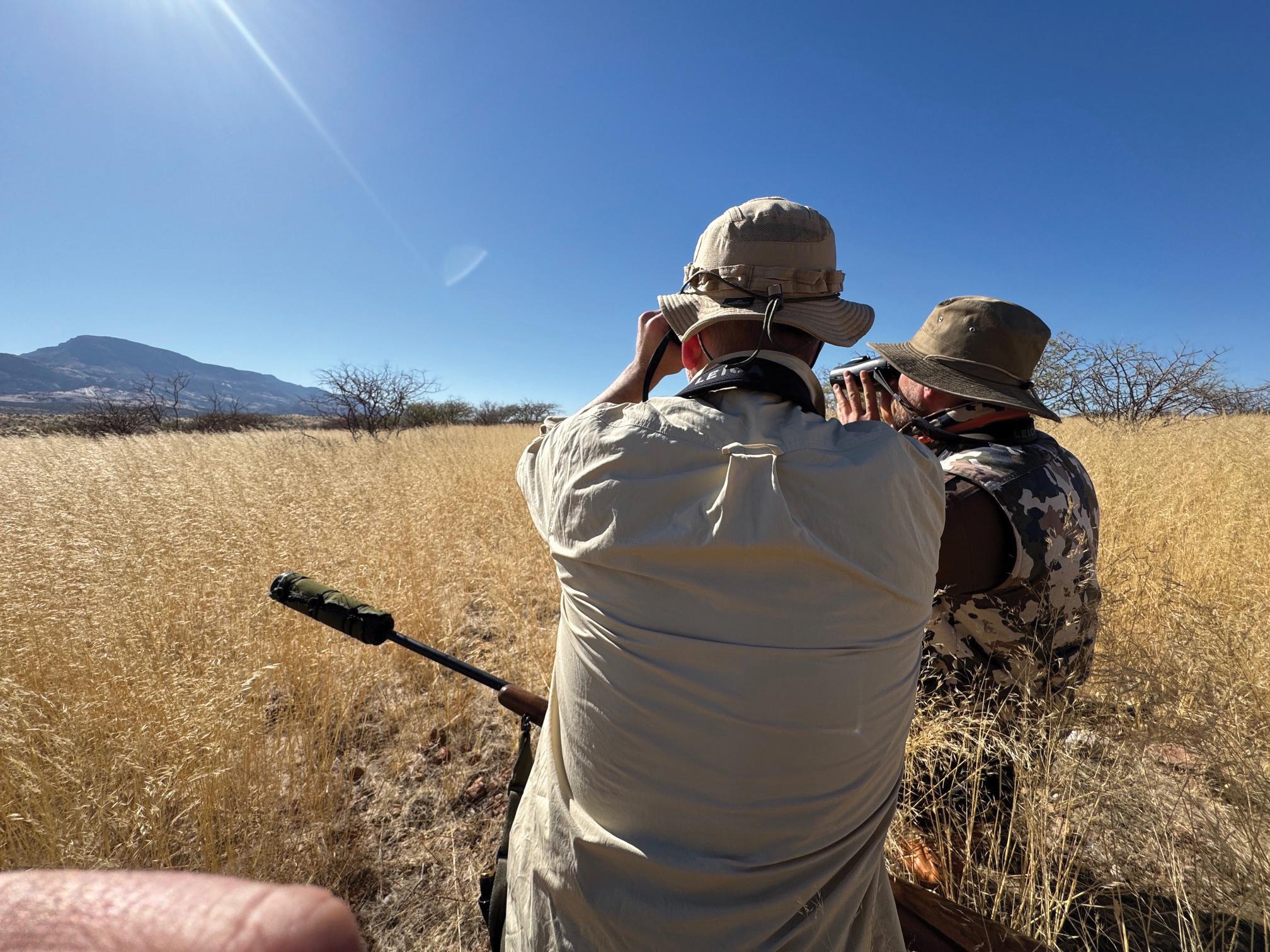
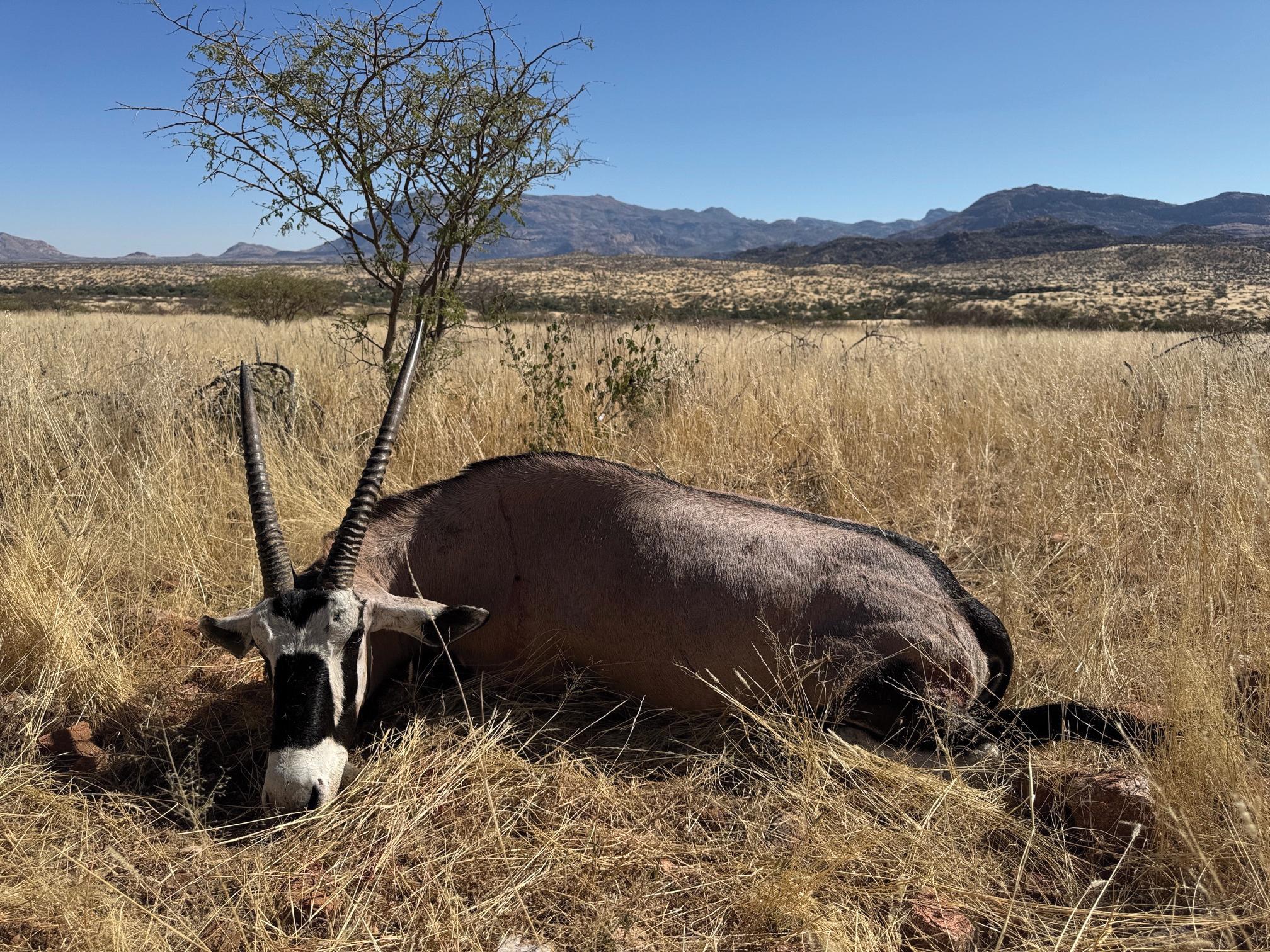
After a brisk walk on the third day of the hunt we climbed up onto a mountain ridge and glassed the wide savannah landscape stretching out some two kilometres below us in the valley between the ridge and the mountains beyond. After glassing for quite some time, Hagen identified an old gemsbok bull with worn horns. The bull had clearly passed his prime, and our excitement rose immediately. At first, the bull moved a little further, but then he bedded down in the sparse shade of a thornbush.

Our strategy was to briskly move upwind, across several smaller ridges and through a dry riverbed, to close the distance to the bull to shooting range. Unnoticed, we got to within about 300 metres of the old warrior. Then, down on our knees, we continued to about 120 metres – and when Hagen gave the all-clear, Holger let fly. The bull dropped instantly but still kicked his hind legs. Hagen explained that it can actually be a warning sign when a gemsbok – in principle a very tough animal – collapses instantly. So we remained at the ready for ten minutes. Then, as we wanted to move closer, the bull indeed jumped up again and veered off to our left. It took a couple of shots to bring him down for good.

“Above us, the magnificent constellation of the Southern Cross was shining against the backdrop of the Milky Way – we felt like strangers but somehow also at home.”

There the old bull was now lying before us in the grass. Our first hunting success in Africa according to the criteria of the Erongo Verzeichnis. A special moment that has burned itself deeply into our hunter’s hearts. We skinnd the bull and after quartering the carcass, we carried the venison and trophy in three long trips to where Hagen had brought the Land Rover. Back at camp we ended the day with an early dinner, and after some lively conversation we all fell into our camp beds utterly exhausted.

The next morning it was my turn in our 2:1 rotation as hunter number one behind Hagen. Our sightings in the hunting days that followed became ever more spectacular. Once, two jackals paused about 100 metres away from us and stared intently in our direction. But their attention was not directed at us – but at a leopard which was cautiously slinking through the tall bristlegrass between the jackals and us.. To watch such an imposing predator in daylight and at such close range leaves you lost for words.

On another stalk, as we were glassing, the “grey ghost of the mountains” suddenly appeared as if out of nowhere. A magnificent kudu bull accompanied by seven cows. However, Hagen decided that this bull, in the prime of his years, should continue on his way. And so we were able to watch him for quite some time as he majestically moved into open ground, before disappearing again behind bushes and trees. Shortly afterwards a young zebra stallion approached to within 90 metres – he seemed aware that he was safe from us, since we had excluded zebra from our hunt. Above us, a buzzard circled and the mating calls of a black korhaan filled the air.

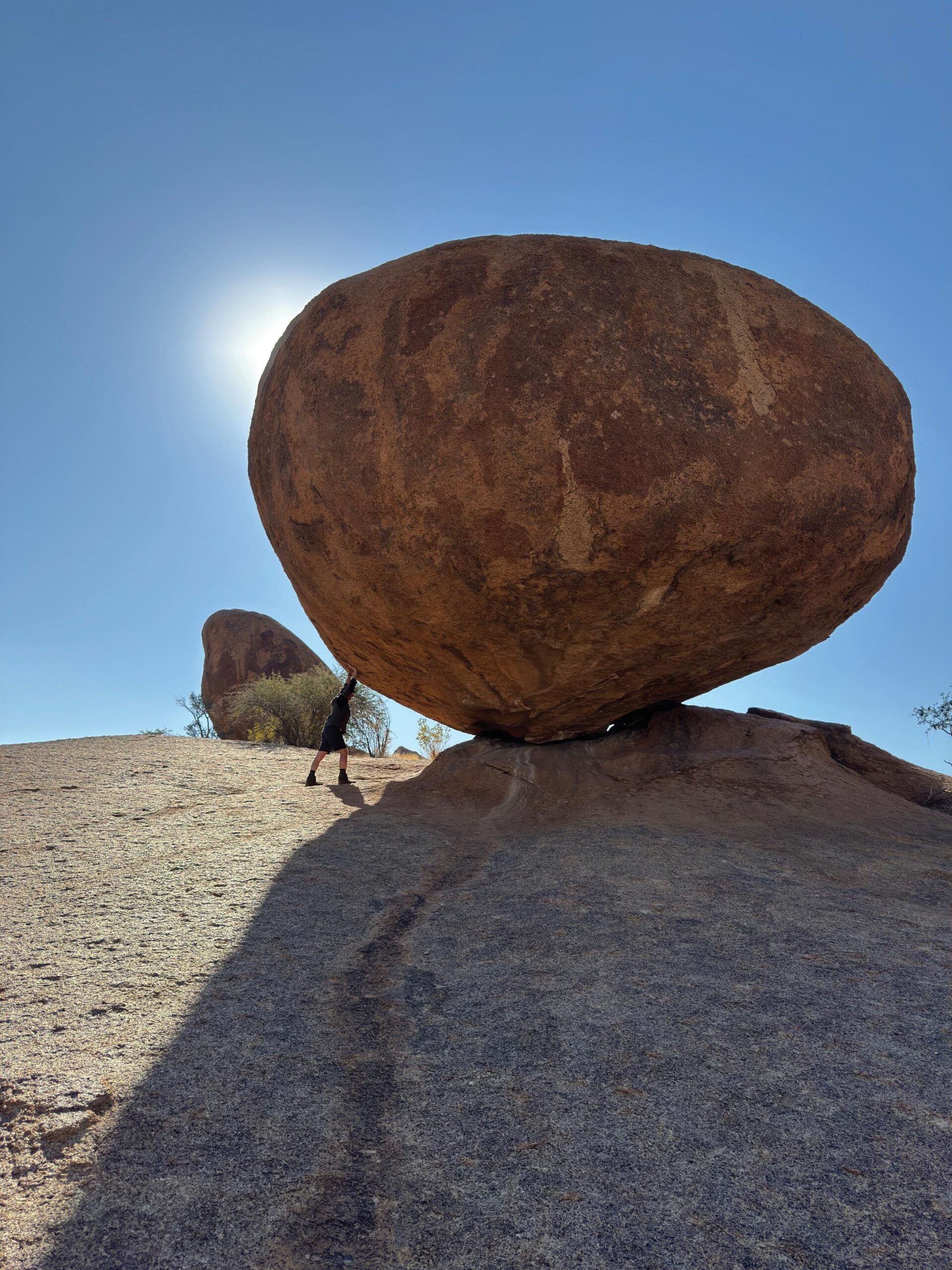
The following day we set off even earlier and drove to the other side of the hunting concession into the rocky terrain beyond. We passed the vehicle tracks leading to the well-known Philipps Cave (a rock shelter, inhabited by the indigenous San people apparently already more than 2,500 years ago, open at the front and full of ancient rock paintings of animals and people) as well as the rock named Elephant’s Head and the Bulls Party area – smooth, red rock formations, 130 million years old, and egg-shaped boulders that seemed as if the gods themselves had bowled with them. Hagen told us that the Elephant’s Head actually features in the classic movie The Gods Must Be Crazy. Following narrow trails and scrambling over some broken granite, we reached a wide granite saddle. Crouched low and moving cautiously, we crossed the saddle and arranged ourselves among the rocks on the slope for glassing. About 500 metres away, three black-faced impala rams came into view. We decided to stalk them.

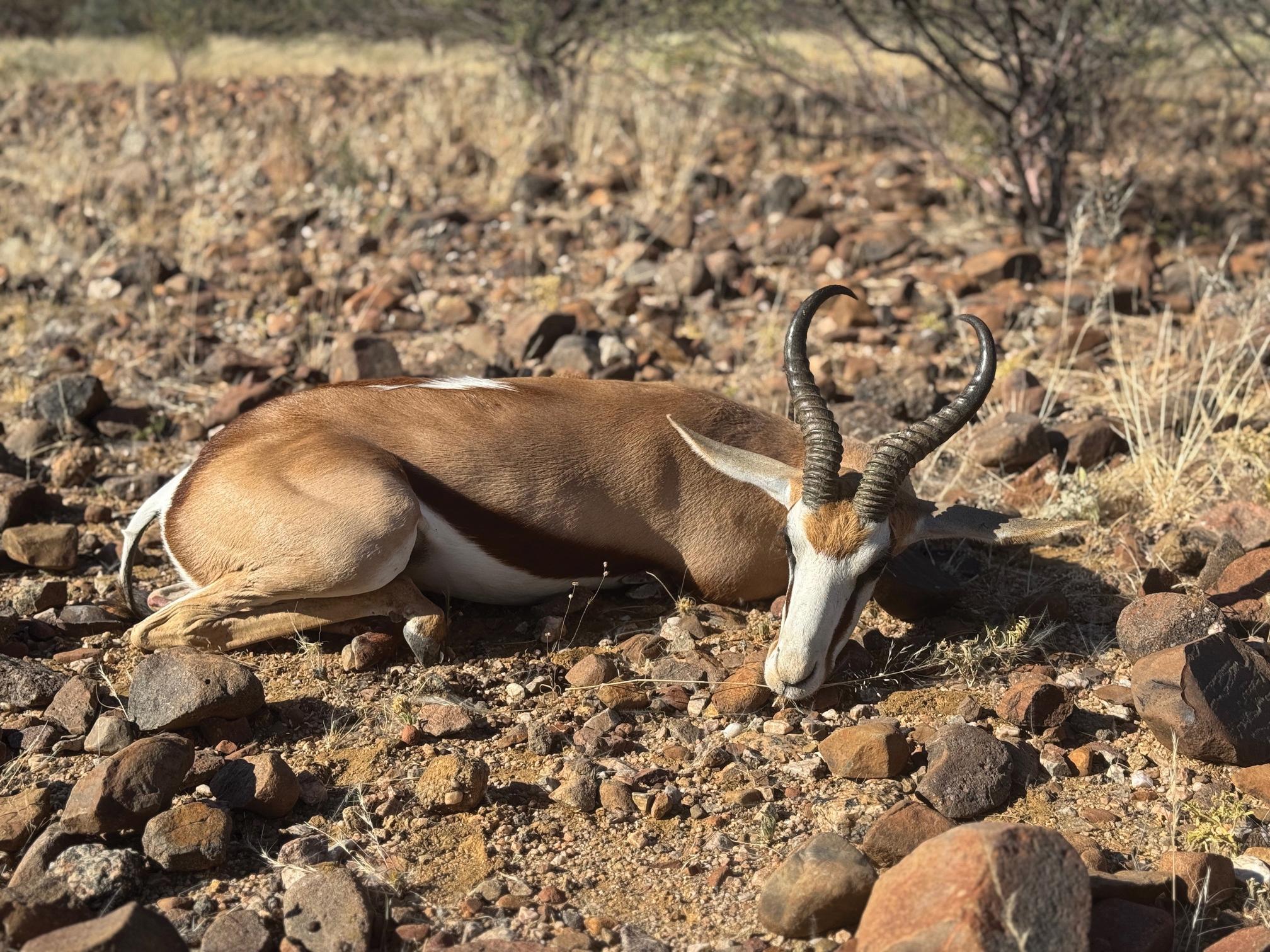
However, after stalking for quite some time – it was already late afternoon – we could not find the rams and on a hunch slowly moved along a dry riverbed when we happened onto a group of twelve to fifteen springbok. They stood close together and were partly hidden by bushes. Several mature old rams were clearly visible. After confirming the target with Hagen, I fired the Mauser from 170 metres. The ram was hit, and the whole group ran off. We waited five minutes, then followed up and found the ram about 50 metres from the point of impact, lying on a rocky patch. We then gutted the springbok, and Hagen set off to fetch the Land Rover. Meanwhile, I lifted the ram onto my shoulders and carried him down to the dry riverbed and still several hundred metres further to where we met Hagen. We delivered the ram to Ameib for hanging and butchering.

The following day we drove back to the Ameib Guesthouse and hiked to the geological attractions mentioned above, i.e. Philipps Cave and Bulls Party. It was a very scenic hike of approximately 10 km, and the ancient rock art left in the cave by San people was truly impressive. There was nobody but us in this magnificent landscape.

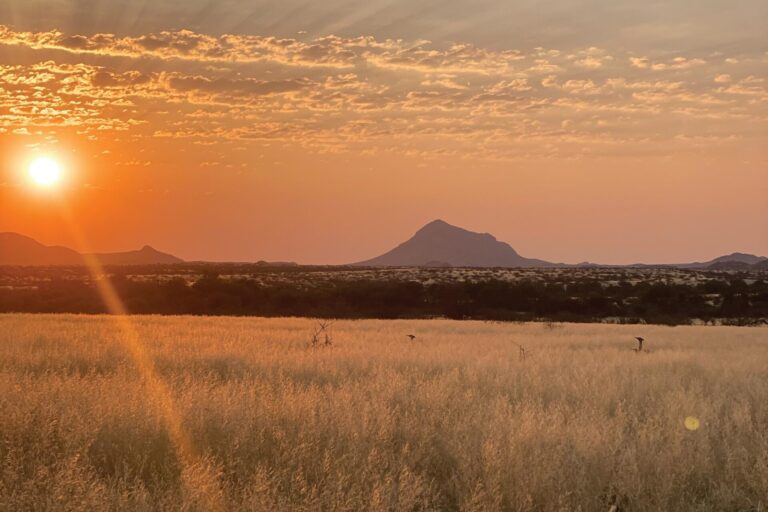
On the last day we went stalking once more in the morning and evening and enjoyed another breathtaking, golden sunset.

On the day of our departure we were treated to a substantial and delicious breakfast buffet at Ameib, and the Denker family warmly bid us farewell.

Summing up, we have been privileged to experience a fantastic and challenging wilderness hunt in the Reficiens Private Hunting Concession at the foot of the Erongo Mountains. The fact that we “only” bagged one animal each during our nine hunting days did not bother us in the least. The overall experience, and with it the selfimposed restrictions on hunting, were more fulfilling than we had ever imagined. We can fully identify with the ethical standards for hunting which Namibia advocates and exemplifies, and with the approach of focusing not primarily on the trophy but on the overall experience of the hunt.

Thus the name of the game is: once in Namibia, always in Namibia. The next Tafel debrief is already in the pipeline.

From the 2026 issue of Huntinamibia

Our Partners

Related posts

Teamwork provides the meat

Stories are manifold of the great springbok migrations in the South African Free State and up the Karoo towards the end of the 19th century, a migration (or trek) that involved many thousands of springbok and formed herds of several kilometres wide. Farmers and hunters of those times told of

Read More »

Tafel Debrief in Namibia

Experiencing intense moments in nature, embracing physical exertion and deprivation as a challenge in order to come to know hunting in a way that is rarely possible in today’s hunting grounds in Germany. This was the motivation for my hunting companion Holger and me to travel to Namibia.

Read More »

Wilderness Hunting Adventure

That is why I came here: to put my hunting skills at the service of a community. My first African safari, in pursuit of the Greater Kudu five years ago, brought me to the magnificent backdrop of the Erongo Mountains. It was an intense combination of strenuous hiking and meditative

Read More »

Read the full 2026 issue